

Introduction
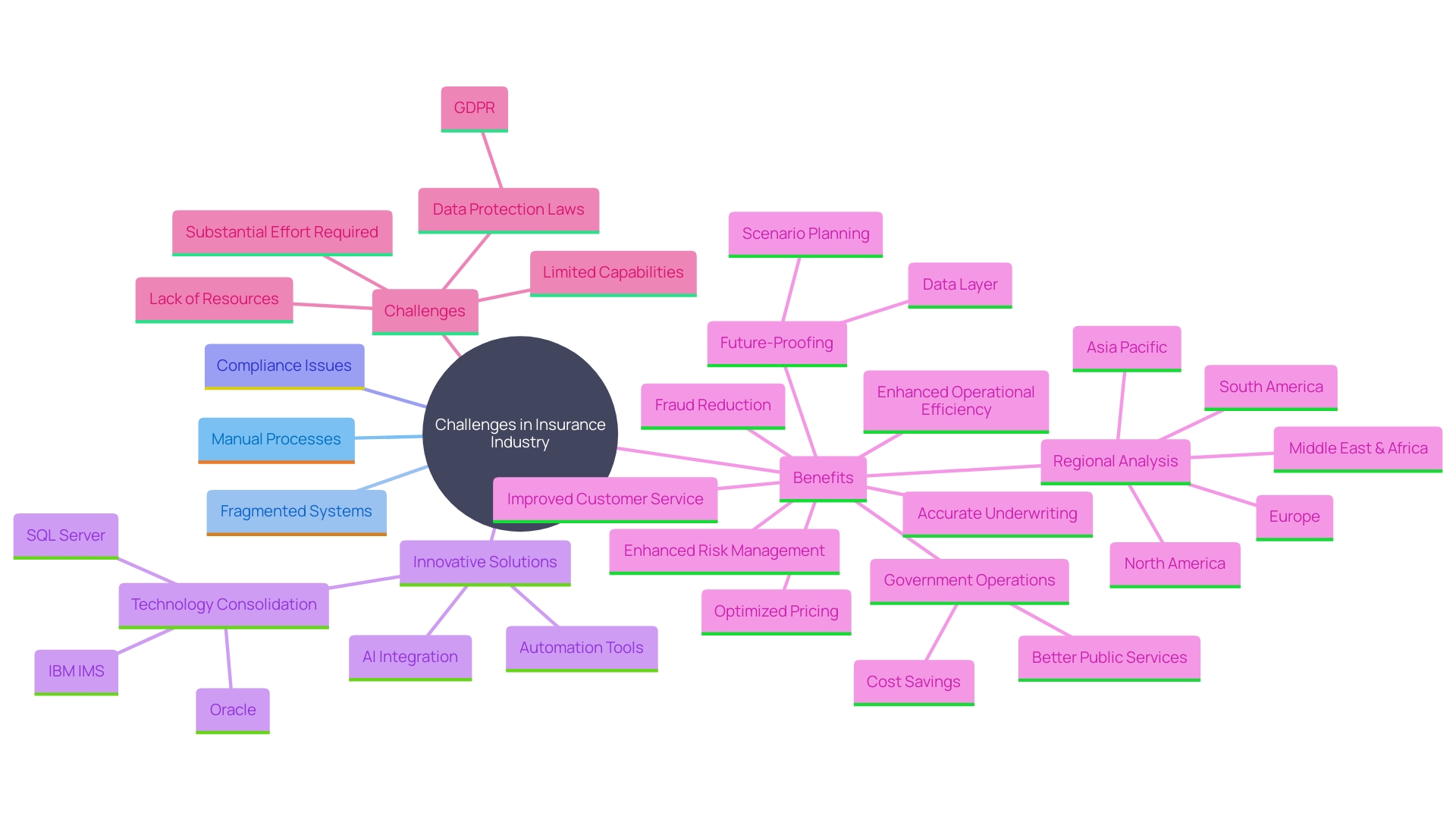
In the ever-evolving landscape of the insurance industry, operational efficiency remains a paramount concern, grappling with a myriad of challenges such as manual processes, fragmented systems, and stringent regulatory requirements. These obstacles not only slow down operations but also inflate costs and increase the likelihood of errors. However, innovative solutions like technology consolidation and the integration of AI-driven processes are paving the way for significant advancements.
By streamlining underwriting, enhancing customer service through virtual assistants, and leveraging advanced analytics for data-driven decision-making, insurers can transform their operational models. This article delves into the key challenges faced by the insurance sector and explores how embracing technology and automation can drive efficiency, reduce costs, and ultimately improve customer satisfaction.
Key Challenges in Insurance Processes
The insurance industry faces numerous challenges that can hinder operational efficiency. Manual processes often lead to delays, errors, and increased workloads for employees. Fragmented systems result in poor data integration, making it difficult to access accurate information quickly. Additionally, compliance with regulatory requirements demands significant time and resources. These challenges necessitate innovative solutions to streamline operations and enhance overall efficiency.
One effective approach is consolidating existing technology portfolios, which often include diverse systems like SQL Server, Oracle, and IBM IMS. Consolidation reduces inventory and prepares insurers for the future by ensuring a robust data layer that supports scenario planning and future-proofing. For instance, integrating AI-driven underwriting processes can significantly improve the accuracy of risk assessments and premium calculations. Chatbots and virtual assistants offer round-the-clock customer assistance, simplifying processing and improving customer service experiences.
Moreover, insurers must carefully select automation tools for claims processing, considering factors like scalability, seamless integration with existing systems, and compliance with industry regulations. Precise and dependable instruments are essential for managing intricate activities such as fraud detection and approvals. These tools not only reduce operational costs but also empower employees by automating repetitive tasks, allowing them to focus on more strategic roles.
Real-world examples illustrate the importance of balancing advanced technology with human interaction. As stated in a report by Capgemini, integrating AI-enabled processes with human interactions is crucial for delivering high-quality service. This balance ensures that insurers meet the diverse needs of policyholders, underwriters, claims reps, and agents, ultimately enhancing overall operational efficiency.
Additionally, the surge in demand for data-driven decision-making is a critical market driver. Insurers utilize extensive information produced by policyholders, IoT devices, and external sources to gain deeper insights into consumer behavior and risk factors. Advanced analytics tools enable more precise underwriting, optimized pricing, and enhanced fraud detection, ultimately boosting profitability and client satisfaction.
In conclusion, addressing these challenges through technology consolidation, careful automation tool selection, and data-driven strategies can significantly enhance operational efficiency in the insurance industry. By embracing these innovative solutions, insurers can streamline their operations, reduce costs, and provide better services to their customers.
How RPA Transforms Insurance Processes
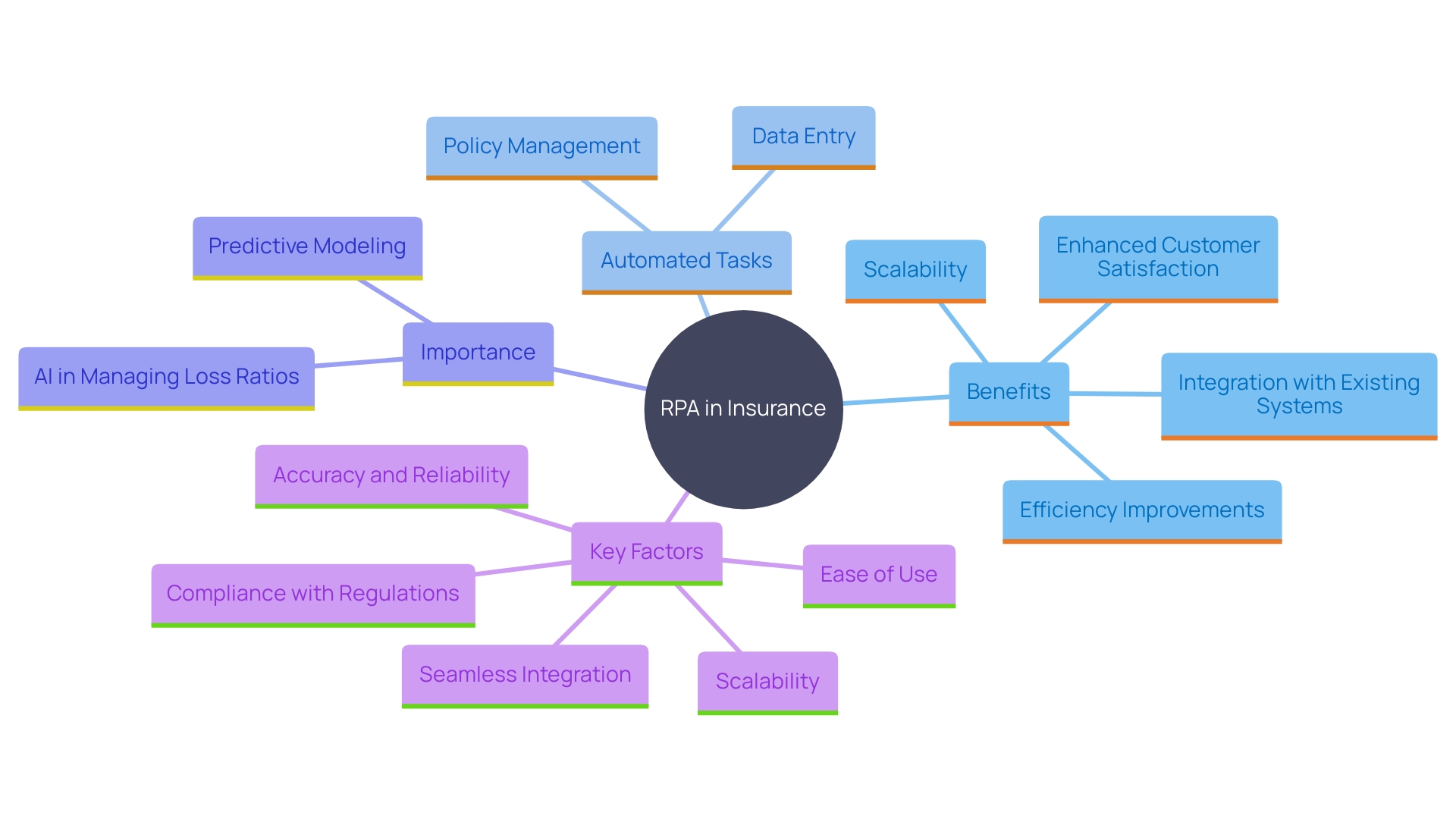
Robotic Process Automation (RPA) is transforming the insurance sector by automating repetitive and labor-intensive activities, resulting in substantial efficiency improvements. For instance, Cognizant’s collaboration with Alm. Brand Group in Denmark highlights how RPA can transform business processes previously outsourced to other vendors. By automating tasks such as data entry, validation, and policy administration, insurers can dramatically accelerate processing and policy management. This not only enhances accuracy and reduces operational risks but also allows employees to focus on more strategic activities, ultimately improving customer satisfaction.
A key aspect of implementing RPA in insurance is ensuring scalability to handle increasing volumes of claims and integrating seamlessly with existing claims management software. This integration reduces interruptions and guarantees adherence to industry regulations, which is vital for preserving the precision and dependability of intricate activities such as fraud detection and approvals. Moreover, the use of intuitive interfaces makes these tools accessible to employees without extensive technical expertise, streamlining operations further.
The benefits of RPA in insurance are evident in improved customer experiences and competitive advantages. By automating routine tasks, companies can handle more requests in a shorter period, offering a quicker and more dependable service to their clients. This transformation is essential in an industry where the loss ratio, the percentage of premiums paid out as payouts, is a critical metric for financial health. Predictive modeling and AI can further enhance these benefits by offering powerful tools to manage and reduce loss ratios, ensuring long-term profitability and stability.
Benefits of RPA in Insurance
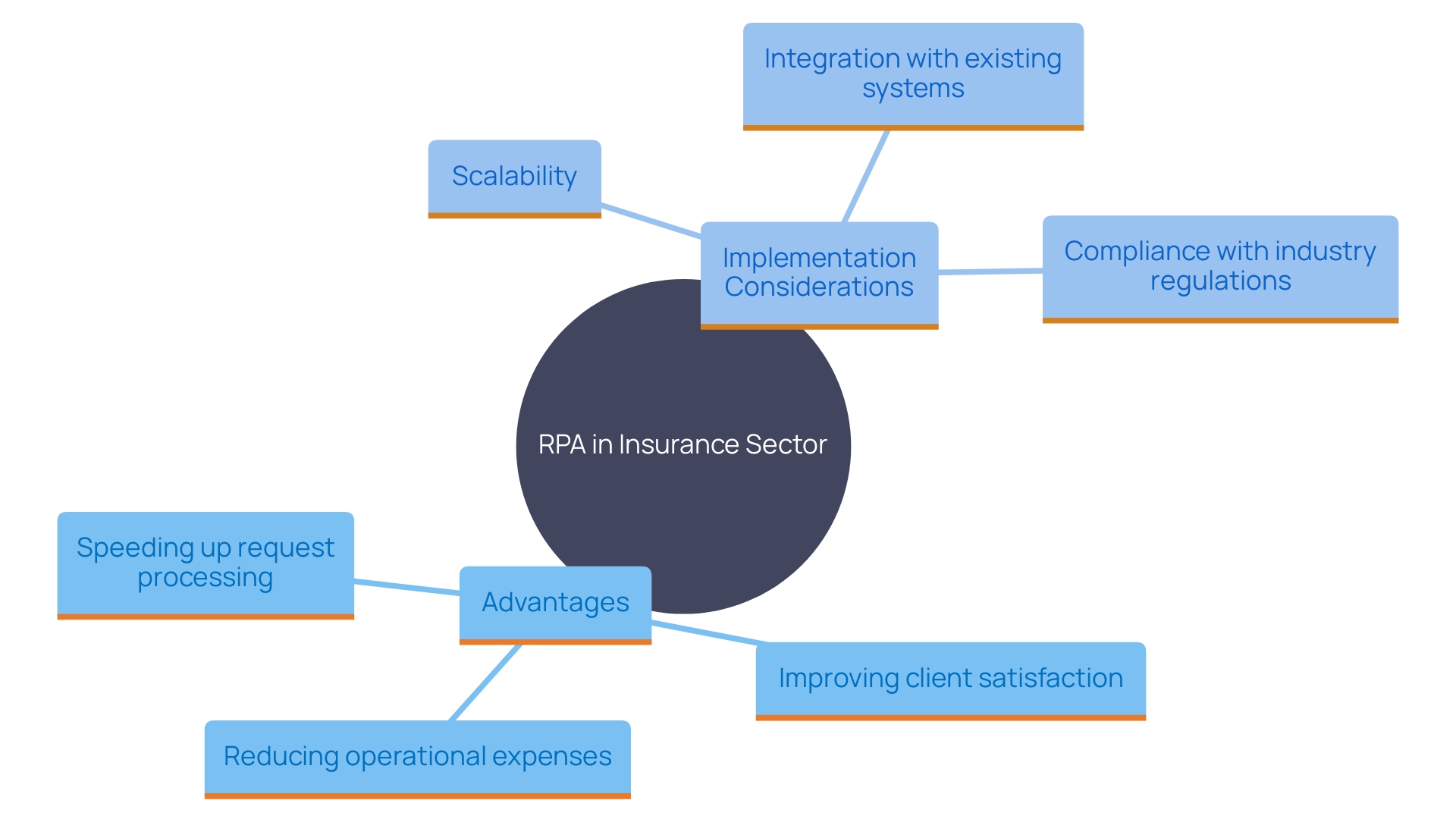
Implementing Robotic Process Automation (RPA) in the insurance sector offers significant advantages. It significantly speeds up request processing, shortening resolution durations and improving client satisfaction. By automating routine tasks, RPA ensures quick responses to inquiries and efficient communication, leading to better customer service. Furthermore, RPA integrates data across multiple platforms, improving accuracy and ensuring compliance with industry regulations. This not only lowers operational expenses but also enhances scalability, enabling insurers to manage increasing amounts of requests effortlessly.
Automation tools for processing requests must be scalable to accommodate increasing volumes and adaptable to future business needs. They should integrate seamlessly with existing management software to prevent disruptions during implementation. Precision and dependability are essential, particularly for intricate activities such as fraud detection and approvals. Compliance with industry regulations is essential to ensure legal adherence in claims processing. Lastly, an intuitive interface is vital for ease of use, allowing employees to operate the tools and interpret results without extensive technical expertise.
RPA’s capability to operate continuously without interruptions greatly accelerates repetitive procedures like data entry, invoice handling, and client inquiries, enabling workers to concentrate on more valuable activities. This continuous operation eliminates the need for overtime pay or temporary staff during peak seasons, leading to substantial cost savings. The high accuracy of RPA also reduces human errors in data entry and report generation, saving money and enhancing work quality. Consequently, RPA is a valuable asset for insurers, improving efficiency, reducing costs, and providing better service to customers.
Implementation Strategies for RPA in Insurance
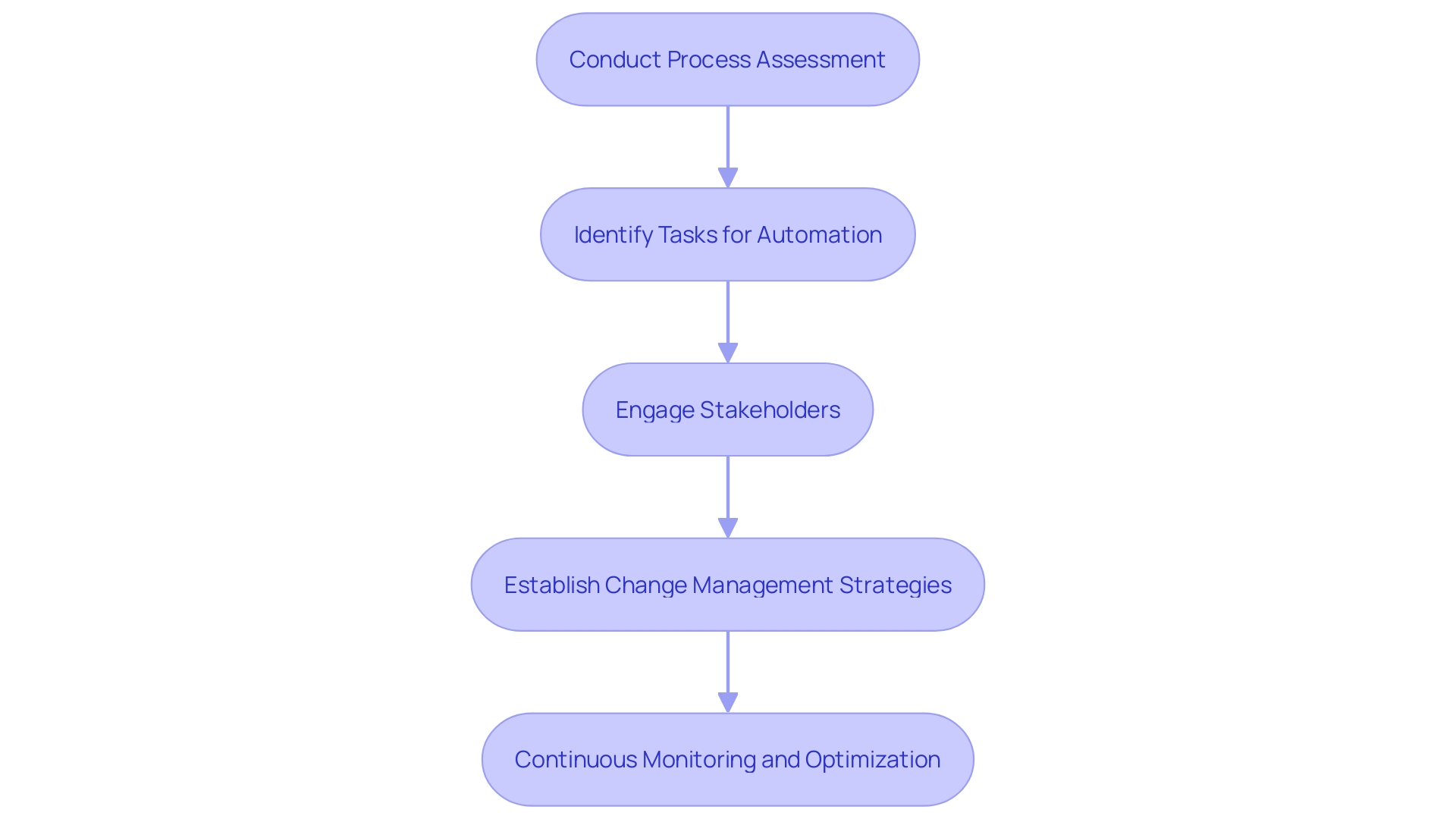
To successfully implement RPA in insurance, organizations should begin with a thorough assessment of their processes. This involves identifying high-volume, repetitive tasks suitable for automation, which can significantly reduce manual labor and errors. For instance, Aflac’s automation of claims review has drastically cut down the time spent on manual checks, allowing representatives to focus on final accuracy verification.
Engaging stakeholders from various departments ensures that all perspectives are considered, fostering a culture of collaboration and reducing resistance to change. This is crucial as the goal of RPA is to enhance process efficiency, better data accuracy, and lower costs, without requiring extensive programming knowledge from users.
Establishing a robust change management strategy is equally important to address employee concerns and promote a supportive environment. Continuous monitoring and optimization of RPA systems are essential for maintaining their effectiveness and adaptability. As noted, RPA combined with AI can transform processes, increase efficiency, and enable more informed decision-making, a sentiment echoed by industry leaders.
By leveraging advanced analytics and continuous oversight, insurers can harness vast data to improve risk assessment, underwriting, and fraud detection, ultimately enhancing customer experiences and profitability.
Conclusion
The insurance industry is navigating a landscape filled with significant challenges that impede operational efficiency. Manual processes, fragmented systems, and stringent regulatory requirements create barriers that can lead to delays, increased costs, and higher error rates. However, embracing technology consolidation and automation, particularly through solutions like Robotic Process Automation (RPA) and AI-driven processes, offers a pathway to overcoming these obstacles.
By integrating advanced technology, insurers can streamline underwriting processes, enhance customer service, and leverage data analytics for more informed decision-making. RPA, in particular, automates repetitive tasks, allowing employees to focus on more strategic roles, thereby improving both productivity and customer satisfaction. The collaboration between technology and human expertise is essential, ensuring that customer needs are met effectively while maintaining high operational standards.
The implementation of these innovative solutions not only reduces operational costs but also positions insurers to respond effectively to the increasing demand for efficiency and accuracy in claims processing. The ability to adapt and scale automation tools ensures that insurers can handle growing volumes of claims while remaining compliant with industry regulations. In summary, by addressing the key challenges with a focus on technology and automation, the insurance sector can transform its operational models, ultimately leading to enhanced efficiency, reduced costs, and improved customer experiences.
Frequently Asked Questions
What are the main challenges faced by the insurance industry?
The insurance industry faces various challenges, including manual processes that lead to delays and errors, fragmented systems that hinder data integration, and significant resources required for regulatory compliance. These issues can negatively impact operational efficiency.
How can technology consolidation benefit insurance companies?
Consolidating technology portfolios, which may include diverse systems like SQL Server and Oracle, helps reduce inventory and ensures a robust data layer. This prepares insurers for future needs by enhancing data accessibility for scenario planning and operational efficiency.
What role does automation play in claims processing?
Automation tools are essential for claims processing as they need to be scalable, integrate seamlessly with existing systems, and comply with industry regulations. Effective automation reduces operational costs and allows employees to focus on strategic tasks instead of repetitive ones.
How does integrating AI improve insurance operations?
AI-driven underwriting processes enhance the accuracy of risk assessments and premium calculations. Additionally, AI tools like chatbots and virtual assistants improve customer service by providing round-the-clock assistance.
Why is a balance between technology and human interaction important?
Balancing advanced technology with human interaction is crucial for delivering high-quality service. This approach ensures that the diverse needs of policyholders, underwriters, claims representatives, and agents are effectively met, enhancing overall operational efficiency.
How are data-driven strategies impacting the insurance sector?
The demand for data-driven decision-making is increasing in the insurance sector. Insurers utilize extensive data from policyholders and external sources to gain insights into consumer behavior and risk factors, leading to improved underwriting, pricing, and fraud detection.
What advantages does Robotic Process Automation (RPA) offer to insurers?
RPA automates repetitive and labor-intensive tasks, leading to faster processing times, improved accuracy, and enhanced customer satisfaction. It allows employees to focus on more strategic activities and reduces operational risks.
What factors should insurers consider when implementing RPA?
Insurers should ensure that RPA tools are scalable, integrate smoothly with existing claims management software, and comply with industry regulations. An intuitive interface is also vital for ease of use among employees.
How can organizations successfully implement RPA in their operations?
Successful RPA implementation involves assessing processes to identify tasks suitable for automation, engaging stakeholders across departments, and developing a robust change management strategy. Continuous monitoring and optimization of RPA systems are also crucial.
What is the impact of RPA on operational costs and customer service?
RPA significantly lowers operational costs by reducing the need for overtime or temporary staff during peak periods. It improves customer service by enabling quicker responses to inquiries and handling more requests efficiently.
How does RPA contribute to data accuracy and compliance?
RPA integrates data across multiple platforms, improving accuracy in claims processing and ensuring compliance with industry regulations. This is vital for maintaining the precision of complex activities like fraud detection and approvals.
What is the future outlook for the insurance industry in terms of technology and efficiency?
By addressing current challenges through technology consolidation, effective automation tool selection, and data-driven strategies, insurers can greatly enhance operational efficiency, reduce costs, and provide superior services to their customers.
List of Sources
- Key Challenges in Insurance Processes
- Insurance Analytics Market Size | Growth Analysis Report [2032] (https://fortunebusinessinsights.com/insurance-analytics-market-108489)
- mongodb.com (https://mongodb.com/blog/post/converged-ai-application-datastore-for-insurance)
- indicodata.ai (https://indicodata.ai/blog/reduce-claims-cycle-time-and-improve-business-outcomes-with-automation)
- dig-in.com (https://dig-in.com/web-seminars/building-your-future-ready-insurance-firm-insights-for-tech-transformation?utm_source=dg_linkedin&utm_medium=webseminar&utm_campaign=dg_dig_oracle_webseminar_02272024)
- edgeverve.com (https://edgeverve.com/ai-first-platform/events/accelerate-insurance-through-connected-enterprise?cmpid=SOCTW_WEB_09052024&source=Digital&subsource=Social)
- dig-in.com (https://dig-in.com/news/capgemini-how-life-insurers-can-improve-customer-experience)
- dig-in.com (https://dig-in.com/news/startup-atidot-uses-ai-for-life-policy-service-and-marketing?utm_campaign=editorial-content&utm_medium=organic&utm_source=twitter)
- indicodata.ai (https://indicodata.ai/blog/navigating-digital-transformation-in-insurance-insights-from-parul-kaul-green)
- Insurance Analytics Market Size | Growth Analysis Report [2032] (https://fortunebusinessinsights.com/insurance-analytics-market-108489)
- mongodb.com (https://mongodb.com/blog/post/converged-ai-application-datastore-for-insurance)
- How RPA Transforms Insurance Processes
- iot-now.com (https://iot-now.com/2024/08/26/146039-transforma-insights-identifies-nine-key-domains-of-change-for-the-insurance-industry-driven-by-the-use-of-emerging-technology)
- datasciencecentral.com (https://datasciencecentral.com/reducing-insurance-loss-ratios-with-data-science-and-ai-algorithms)
- indicodata.ai (https://indicodata.ai/blog/reduce-claims-cycle-time-and-improve-business-outcomes-with-automation)
- news.cognizant.com (https://news.cognizant.com/2023-11-23-Cognizant-selected-by-Alm-Brand-Group-to-enable-automation-services)
- dig-in.com (https://dig-in.com/list/top-6-ai-insurance-stories?utm_campaign=editorial-content&utm_medium=organic&utm_source=twitter)
- dig-in.com (https://dig-in.com/list/ford-rga-partners-with-digital-owl-insurtech-news?utm_campaign=editorial-content&utm_medium=organic&utm_source=twitter)
- dig-in.com (https://dig-in.com/list/nationwide-digitalowl-progressive-fleet-insurtech-news?utm_campaign=editorial-content&utm_medium=organic&utm_source=facebook,linkedin,twitter)
- indicodata.ai (https://indicodata.ai/blog/reduce-claims-cycle-time-and-improve-business-outcomes-with-automation)
- mckinsey.com (https://mckinsey.com/industries/healthcare/our-insights/the-ai-opportunity-how-payers-can-capture-it-now)
- Benefits of RPA in Insurance
- indicodata.ai (https://indicodata.ai/blog/reduce-claims-cycle-time-and-improve-business-outcomes-with-automation)
- corporatesolutions.swissre.com (https://corporatesolutions.swissre.com/insights/knowledge/commercial-insurance-claims-podcast/ai-adaption-claims-insights-podcast-episode6.html?utm_campaign=cpn-1772_rds-global-resclaims_corso_apac_2023&utm_medium=display_organic&utm_source=linkedin&utm_content=digitalisationpodcast_enclaimsPodcastAi)
- datafloq.com (https://datafloq.com/read/benefits-of-robotic-process-automation-for-small-businesses?feed_id=1410&_unique_id=657b00f4a0134)
- dig-in.com (https://dig-in.com/list/ford-rga-partners-with-digital-owl-insurtech-news?utm_campaign=editorial-content&utm_medium=organic&utm_source=twitter)
- dig-in.com (https://dig-in.com/list/top-6-ai-insurance-stories?utm_campaign=editorial-content&utm_medium=organic&utm_source=twitter)
- iot-now.com (https://iot-now.com/2024/08/26/146039-transforma-insights-identifies-nine-key-domains-of-change-for-the-insurance-industry-driven-by-the-use-of-emerging-technology)
- indicodata.ai (https://indicodata.ai/blog/navigating-the-ai-revolution-in-insurance-insights-from-tom-wilde-and-naveen-dhar)
- iot-now.com (https://iot-now.com/2024/08/26/146039-transforma-insights-identifies-nine-key-domains-of-change-for-the-insurance-industry-driven-by-the-use-of-emerging-technology)
- insurancethoughtleadership.com (https://insurancethoughtleadership.com/underwriting/automated-underwriting-new-era-work?utm_content=bufferb929e&utm_medium=social&utm_source=twitter.com&utm_campaign=buffer)
- Implementation Strategies for RPA in Insurance
- techradar.com (https://techradar.com/pro/minding-the-rpa-management-gaps)
- dev.to (https://dev.to/rootstack/mulesoft-rpa-basics-from-start-to-finish-1gi4)
- Insurance Analytics Market Size | Growth Analysis Report [2032] (https://fortunebusinessinsights.com/insurance-analytics-market-108489)
- microsoft.com (https://microsoft.com/en-us/industry/blog/financial-services/insurance/2024/05/01/how-microsoft-copilot-for-microsoft-365-is-redefining-insurance-one-role-at-a-time)
- dig-in.com (https://dig-in.com/list/top-6-ai-insurance-stories?utm_campaign=editorial-content&utm_medium=organic&utm_source=twitter)
- us06web.zoom.us (https://us06web.zoom.us/webinar/register/WN_zHcOSIAITsG8fRglhoX5Dw)
- iot-now.com (https://iot-now.com/2024/08/26/146039-transforma-insights-identifies-nine-key-domains-of-change-for-the-insurance-industry-driven-by-the-use-of-emerging-technology)
- onpassive.com (https://onpassive.com/blog/how-do-we-enhance-business-processes-with-rpa-and-ai)
- techradar.com (https://techradar.com/pro/minding-the-rpa-management-gaps)
- codingcrafts.io (https://codingcrafts.io/blog/how-does-robotic-process-automation-rpa-differ-from-intelligent-automation-ia)